Showing posts with label game. Show all posts

Saturday, October 19, 2013

The Times, They Are A-Changin'


Over the past few years, I've seen a certain change in my interests. Both in how I spend my time and how I regard life in general. For instance, since summer camp '12, I value time with friends much more highly than I did before that time.

I don't play as many video games as I used to. When I was fifteen, I was playing at least eight hours of WoW every day. These days, I'd often rather be working. Sure, I still play several hours of video games every week (and the fact that I'm counting "per week" should tell you something), but I also value my time spent reading things on the internet. It's not as glamorous, say, as killing Ragnaros, but reading news is just something I enjoy now.

Today I was thinking about RPGs. Since getting Edge of the Empire (and playing it, what, twice?) I've realized the golden age of RPGs in my life has passed. I'll likely never again spend several hours each week planning, discussing and playing RPGs like did in 2009-2011 (or whenever it actually was). These days, my game time is spent playing board games. Rightly so, there are several reasons I enjoy them perhaps more than RPGs.

• I don't have to prep/write anything
• I don't get upset when the week gets cancelled, because it's not a personal blow to my ego
• Other people can bring or play board games, keeping the variety level high
• Board games are games, whereas RPGs are more like a group activity

That last part might be a little contentious. A few years I would have been extremely offended by such a claim. I argue that it's true: RPGs have no winner, no clear goal, no real competition (depending on the system of course). RPGs fail to meet the exact definition of a "game." I'm not suggesting they aren't fun. Oh contraire! Many of my best memories came from playing Savage Worlds. Many in-jokes were created that have lasted to this very day.

There are certain things that can be done with one medium that simply cannot be done in another, but lately we've seen some interesting developments in the world of board gaming that has made them draw ever-closer to the beloved RPG. In fact, video games jumped on that bandwagon years ago. These days you can't shake an AR-15 without hitting a handful of military shooters, racing games or third-person shooters riddled with all manner of RPG mechanisms. Whether it's Call of Duty's amazingly fun ability to level up your soldier, unlocking new guns and perks or The Last Of Us's slow trickle of parts to upgrade your favorite weapons, the systems are here to last. Rightly so, they reward players for continued investment. They get to tweak the game in the direction they want to take it. Go ahead and try to play Unreal Tournament 2004 again, I dare you. Without the ability to level up, the player is left with an overwhelming feeling of "why waste the time?"

Can board games do the same thing? The venerable Hero Quest was Milton Bradley's answer to Dungeons and Dragons, creating a whole new genre of board game: The Dungeon Crawl. Since 1990 that genre has seen notable entries such as Lego's Heroica and Fantasy Flight's Descent, my personal favorite dungeon crawl. These games have variable amounts of customizability and player agency in regard to their character's progression, but it's a very small amount compared to a full-fledged role-playing game.

The real question is, "how much farther can we go?" board games have only really come into popularity in the last ten years or so, due in part to the fact that they've become sophisticated and interesting enough to hold the attention span of young people. For many of my gamer friends, being a gamer extends to games in all mediums, not just ones made of pixels. There is no exclusivity, and no need for it.


What new mechanics could board games borrow from RPGs, or even video games? Games like Risk Legacy introduced the novel concept of permanently changing the game board. Descent has a progressive campaign system that allows players to "level up" their characters between adventures, including purchasing equipment from shops between quests. There's a level of permanence that has previously been unseen in this world of cardboard and paper.

I'm very curious to see where the we can go.

Saturday, December 18, 2010

It Stands For Death & Dismemberment

Now, I've written a few stories in my time. A few of them even have endings. A few of those actually have decent endings. Something I've never written, however, is a story for a game.
I've always been curious about Dungeons and Dragons, but I've always been turned off by the amount of stat comparisons, difficulty checks, dice rolls and general other nonsense that has to happen in order to have fun. I'm much more interested in the narrative part of the game; it's a video game where almost anything can happen! It's much more of a sandbox than regular games, because you're playing with someone's interpretation of the game rules, not with a computer whose rules are set in stone.
Because of this interest, and because of some new friends who are alright with the idea, I endeavored to create something that I call Dungeons and Dragons Ultra Light, loosely using the naming conventions of fonts, whose weights are measured in degrees from Bold to Ultra Light. That's right, now I'm at least two kinds of geek.


Like the kind of guy who makes a steampunk 20-sided die.

Essentially my game (playfully referred to as D&D Ultra) is the poor man's version of the regular game: There are no game boards, stat sheets, miniatures, and there's only one type of die. The ol' 20-sided, or d20 as it's known to players.
I sketched out some basic rules that made the game play more like an old Lucas Arts adventure game than D&D. It made me realize that the only thing that sets my D&D Ultra apart from, say, Monkey Island or Full Throttle (apart from their games having significantly better writing) is the random dice rolls. In Full Throttle, if you want to open a locked door, you'd click “open” and he'd say, “I need a key for that.” In my game, if you want to open a locked door, I might have you roll the die to pick the lock or use a spell to open it. This is actually what I wanted, because my interest with D&D has always been more with the social interaction than the combat. The dice rolls help keep things interesting.


Rolling dice in this game would only slow down the awesome.

Here's where we get to the portion of the blog that actually talks about writing. When I set out to make a game for my group to play, the first thing I did was search around for a usable pre-made campaign that I could use. Unfortunately the ones I found used a format I wasn't familiar with, and the adventures were far too in depth for some of the people in my group. Although I knew nothing about D&D, let alone writing a campaign, I decided to dive in headfirst and write my own anyway. During one sleepless night, I wrote out the first four areas of the campaign in my head. The next day I sat down and committed my ideas to paper (well, to a word processor) and added enough extra stuff to finish the story. It's very simple, really. As an actual story it wouldn't hold up at all. Frankly I just wanted to make a few interesting areas for my friends to run around in.
Once we actually played it, I learned what I did right and wrong. I previously knew I couldn't anticipate every action the group wanted to take. I naively assumed the group would loosely follow the path I gave them. I had a few interactions and descriptions on paper that I could read off, but 90% of the time I was making things up on the fly, which was immensely fun, but it would have been nice to have something to reference.

For instance, in the first area you have a few people you can talk to: The bartender, the barmaid, an old soldier and a really drunk guy. (It already sounds a little like Monkey Island, huh?) You can talk to all of them, but I had only written responses to one question for each character, and naturally those were the questions nobody asked. I also discovered that my group almost consistently either wanted to flirt with everyone or simply murder them. I was almost prepared; I had written in difficulty rolls for Flirting, Threatening and Bluffing. However, I didn't anticipate the murderous nature of my friends, which in itself is a little frightening.

It turns out that it takes many, many pages of text to be fully prepared for the group's choices. I found a free D&D campaign off the company's website and now I better understand what it says. If you flip to the back there are tons of little paragraphs detailing what happens when a player touches X thing or threatens X person. It's a little bit like programming a video game, except it requires no programming, just a lots writing.
It's a great writing challenge, and yet I find myself wanting to write many, many more adventures.

Thursday, September 2, 2010

The 3D People and Their Magical 2D World


If you're half as nerdy as me, you might have tried to write stories that take place inside your favorite video games. If you're really nerdy then the games in question are probably really obscure, and if that's the case then this probably isn't the blog for you.

I'm not talking about old video games like Pitfall or Pac Man (cough), but rather more recent games (circa 1990 at least). At first glance, a video game with a good story or good universe can be quite appealing to write about. If you remember games like Decent, Commander Keen, King's Quest, Space Quest and Cosmic Cosmo, then you're old enough to appreciate the tender deliciousness of games that helped stimulate the imagination of my childish mind.

Ur, childish because I was a child when those games came out. Literally childish.

You have to remember that most of those old games didn't have much in the way of story except maybe a screen or two of poorly-written narrative set in some grainy 16-bit font.

Even if I could have read the story, which I couldn't, I would have found a rather thin excuse to have the player collect the Red Key Card or kill snails or defeat Mordak. Well, King's Quest actually had a pretty good story. There was actually a pretty good reason to defeat Mordak.

Ahem.

As a young player of these games, I was interested in making the characters from the games have additional adventures. I wasn't trying to make an expanded universe or add impressive self-inserts of myself; I guess I just wanted new levels. I could kind of reach that goal via writing. It always turned out awful, but thad whad Id ecpect frm a chlid hoo culdn't spelle very well.

Fast forward to Christmas 2004 when my family finally got DSL and I got a new game for Christmas called World of Warcraft. You know where this is going.

Long story short, I played the heck out of the game, and eventually tried my hand at writing inside the universe. It's not the worst thing in the world; I'm definitely not the first person to try this kind of thing. After all, Warcraft has enough story to fill several hundred books and enough fans to fill a convention center.

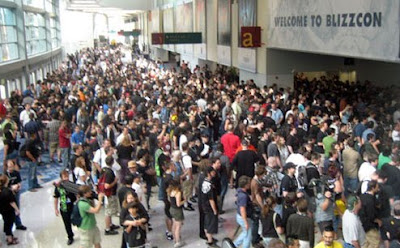
Like at Blizzcon.


For anyone who has tried to write a story inside the universe created by a video game, there are a few things to know:

  1. The designers make gameplay decisions based on how fun they are, not on how accurate they are to real life.

  2. The world is sized to make it fast to walk from place to place, not to make it as big as a real planet.

  3. Everything is streamlined.

For a person trying to write a story inside the game, they're going to encounter these weird hurdles in their storytelling process. If I were just starting out writing a story, lets say it's in Warcraft and I set it in Stormwind, I'm not picturing a real city when I write; I'm picturing the city from the game, which is laughably small compared to a real city. There's no infrastructure. There's no economy; heck, there aren't even people living there.

Now let me just clarify: I don't want people saying, “you just like getting bogged down in the minute details of stupid crap like this, William! It's not relevant to the story!”

I'm not trying to say that you're supposed to add all of the boring things that I've just mentioned, but when you're picturing Stormwind, again, you're picturing the one in the game. If you want to write a more authentic story, you have to imagine a real medieval city, though one that contains magic and stuff. Lets make an illustration.

Lets say that I'm writing a story that's taking place inside a universe that I'm making up. It's completely my own. When I tell you that there's a huge city in the story called Whirlgate, the capital of the Highland nation of Men. It's built on top of a mountain and its buildings scatter down the cliffs, which have been quarried. As they descend the mountain, the buildings become smaller and smaller; the downtown area near the top gives way to residential hovels made of white stone toward the bottom. To keep the wind down, there is a massive twenty foot wall surrounding the entire city. It zigzags up and down the cliff in a strange, random-looking layout.

If your imagination is working properly (and if my writing isn't garbage), then hopefully you pictured something that might exist in the real world. Maybe it looked a little bit like something from Lord of the Rings, but still, it was real. When I say Stormwind you're going to be picturing that location in the game. Static. Polygonal. Video game. This is why I always prefer to make something up from scratch instead of fanficking myself into the corner.

To complicate matters, if your audience is also familiar with the game, they're going to picture the video game version of the city, no matter how flowery and descriptive your language is. This kind of thing happened to me when I read Howl's Moving Castle after seeing the animated feature; I couldn't NOT see the characters as Japanese animation in my head.

Though the movie is still fantastic.


I guess the point of all this is that I don't recommend writing stories inside games. I'm not saying to never do it; you might find you're quite good at it and that I'm full of hot air. If anything, it'll be a helpful learning experience that you can put toward your further writing successes.

(Also, since I didn't have anything Wednesday, I'm posting Friday's blog a few hours early as a sort of "please forgive me" bonus!)